

Invest in medical clinics in Fifth Settlement, New Cairo. Discover promising locations, modern medical units, and opportunities for long-term real estate investment.
Investing in Medical Clinics in Fifth Settlement | Is It Right for You?
A medical clinic is not simply an office with a healthcare sign
A new building on a prominent road can make almost any unit look appealing. A polished lobby, an attractive payment plan, or a large floor plate can add to that first impression. Yet a clinic succeeds as a place people can actually use: patients need to find it, reach it comfortably, wait with reasonable ease, and leave without unnecessary friction. Doctors and operators need a layout that supports their work rather than working around it.
That is why investing in Medical Clinics in Fifth Settlement should not start with the price per square metre alone. Start with a more practical question: who will use this clinic, and what kind of visit must it accommodate? An owner-occupier may be planning a first practice or an established location. An investor may be looking for a unit that appeals to a range of future tenants. In both cases, access, floor position, area, finishing, and permitted use matter as much as the headline price.
Fifth Settlement offers a mix of residential communities, business districts, services, hospitals, and major routes. That variety can support healthcare demand, but it does not make every medical unit equally suitable. The useful approach is to assess a clinic as an operating environment and a potential real-estate asset—not merely as a unit labelled “medical.”
Why is interest in medical units growing?

As residential districts expand and workplaces spread across New Cairo, convenience becomes part of a patient’s decision. People may choose a doctor for clinical reasons, but they also notice whether the address is clear, whether parking is manageable, and whether a follow-up appointment fits into daily life. A location that reduces these small obstacles can make repeat visits easier.
For practitioners and healthcare operators, owning a unit can offer a stable professional address and more control over the environment. Some doctors prefer this to moving between leases, while others choose to rent until their operational needs become clearer. Investors, meanwhile, may look for a space suited to several possible uses—from consulting rooms and dermatology to dentistry, internal medicine, physiotherapy, or other services—subject to the project’s rules and the requirements applicable to the facility type.
Demand for healthcare should not be confused with an automatic promise of fast leasing or a particular yield. Specialties have different layouts, equipment needs, patient volumes, privacy expectations, and technical requirements. A better question is whether the surrounding area produces a realistic user base and whether the unit removes, rather than adds, friction from the patient experience.
Buying for your own practice versus investing for income
An owner-occupier is making an operational decision first. Walk through an ordinary working day: where do patients check in? How will a nurse, assistant, or receptionist move through the space? Is there enough room for a comfortable consultation room and an orderly waiting area? Does the layout preserve privacy? A smaller clinic with a clear route and an efficient plan can be more valuable to a working practice than a larger one that is difficult to use.
An investment purchase requires a broader lens. Do not only ask whether the unit suits your own specialty. Consider how many realistic specialties it could suit, who the likely tenant would be, what comparable units actually rent for, and how long finishing or vacancy could take. You do not need a tenant in hand before buying, but you should be able to identify several credible user profiles rather than relying on one narrow use case.
The cost structure also changes. A doctor opening a practice may reasonably spend more on a tailored design. An investor should separate purchase price, maintenance obligations, finishing costs, permitted alterations, and potential vacancy. When comparing two units, look beyond the monthly instalment: compare the total financial commitment with the flexibility and leaseability the unit could provide.
Neither path is universally better. A stable practice with a clear location strategy may value long-term control. A portfolio investor may place more weight on broad tenant appeal and straightforward access. In either case, a “medical” label does not replace a real operating plan.
Check Now: Office For Sale in New Cairo
Choosing the location

For clinics, location means more than the name of the road. A recognizable address can help, but patients also need a sensible entry route, practical parking, and a simple exit after an appointment. A project may sit on a well-known artery while its entrance is inconvenient for the direction most visitors travel from. A visible façade can still be frustrating if visitors must make difficult turns or navigate unclear pedestrian access.
When comparing clinics for sale in Fifth Settlement, retrace the patient journey rather than relying on a building image. Drive in from nearby residential areas and business districts. Locate the entrance, parking, reception, lift, and the unit itself. If possible, do this at different times of day. One visit can create an impression; several visits reveal traffic patterns, peak congestion, and the practical experience of reaching the clinic.
Also assess where demand may come from. Nearby homes can support services that rely on frequent visits. Office districts may create appointments before or after work. Proximity to healthcare services or a hospital may bring healthcare-related traffic, but it is not a substitute for understanding nearby competition and unmet demand. Buy the connection between the site and the intended patient base, not proximity to a landmark alone.
Choosing the right floor
Ground-floor space can reduce the distance between the street and the clinic. It may work well for services receiving high volumes of visitors or for patients who benefit from direct access. It is not, however, the only sound choice. An upper-floor clinic can operate very effectively when the route is clear, lifts are adequate, reception is organized, and the building groups compatible uses thoughtfully.
Upper floors may suit appointment-led practices and treatments involving regular patient relationships, provided access does not feel like a burden. Before purchasing, do not look only at the floor number. Take the complete route from the parking area or gate to the unit door. Are visitors certain they have arrived at the right entrance? Is the lift wait reasonable? Do medical visitors mix awkwardly with other visitor flows? Is wayfinding useful for older patients, parents, and people with limited mobility?
Compare the floor premium or discount with its real use. A cheaper upper floor is not automatically better if it is difficult to lease or works for only a limited set of specialties. Conversely, do not pay a substantial premium for ground-floor visibility unless your operating model genuinely needs it. The right floor is the one that supports the patient journey and the use case.
Finding the right size
There is no universal clinic size. The right choice begins with the functions the practice needs: reception, waiting, a consultation room, and potentially treatment, sterilization, or storage space, depending on the specialty and the relevant rules. A sole practitioner may prioritize one well-planned consultation room and a modest, orderly waiting area. A multi-doctor practice or a centre with supporting services may need a very different arrangement.
Bigger is not always better. Space beyond operational needs increases finishing, furnishing, and running costs without necessarily improving patient experience. A small unit is not automatically a bargain either; it may constrain waiting capacity, supplies, or staff movement. Sketch a preliminary layout before signing, even if it is simple. Test door locations, service points, windows, walls, and circulation.
For an investor, flexibility is important. Consider whether the space could accommodate more than one logical layout or user profile, within the project’s specifications and any future approvals. A unit that works for several realistic scenarios without expensive alteration has a wider potential tenant pool. Similar square footage does not guarantee similar usability; configuration, frontage, bathrooms, corridors, and service locations can change the answer.
Finishing: practical before decorative
Finishing in a clinic is not just an aesthetic choice. It shapes first impressions, perceived cleanliness, maintenance, and the ability to handle daily use. Practical surfaces, clear lighting, suitable flooring, privacy-conscious doors, and reliable air conditioning all influence patient and staff comfort. Still, no brochure description should replace a review of the actual specifications and what is included contractually.
A semi-finished unit may suit a practitioner who wants a highly tailored identity and layout, but it demands time, budget, and contractor coordination. A fully finished unit can shorten the opening process if the finish is suitable for real use and leaves enough flexibility for the specialty. Ask for a clear scope: electrical points, plumbing, cooling, internet provision, and the permitted alterations all matter.
Investors should avoid over-customizing a unit for one highly specific specialty. A clean, practical base can improve leasability while allowing a future tenant to express their own identity. Include finishing in the total investment cost, and do not assume that a tenant will absorb every improvement without affecting rent or lease terms.
Ease of access
A location can look excellent on a map and still be awkward in practice. Begin at the car park: are spaces and routes understandable? Then trace the path to the entrance, lift, reception, and unit. Wide corridors, intuitive directions, functional lifts, and separate entrances where appropriate can make a visit less stressful—especially for older patients, people with disabilities, and parents accompanying children.
The exit journey matters too. A patient who struggles to leave a garage, pay, or find onward transport may reconsider booking again, even after a satisfactory appointment. Ask about parking management, peak-time conditions, service traffic, and any relevant access or emergency arrangements. These are operational details, but they become part of the practice’s everyday reputation.
If you are looking at a Clinic for Sale in New Cairo, marketing may stress proximity to a major street or district. Treat that as a starting point, not a conclusion. A site visit—or a close review of plans and entry routes when a visit is not yet possible—will tell you more about the actual customer experience.
Payment plans: a tool, not a reason to buy
A payment plan can make a purchase more manageable, but it does not make an unsuitable unit suitable. Start with total price, down payment, instalment dates, and charges related to maintenance, parking, handover, or changes. Then compare that commitment with expected cash flow, not just with your ability to make the first payment.
An owner-occupier should link instalments to the practice timeline: when can operations start, what is needed for fitting out and equipment, and when could revenue begin? An investor needs a conservative scenario that includes possible leasing delays and a tenant’s fit-out period. Do not assume rent will begin immediately at handover or that prices will automatically rise.
Read the complete payment schedule and ask for written clarification of any unclear provision before signing. Confirm due dates, late-payment terms, handover specifications, and maintenance or management obligations. Financial flexibility is valuable when it supports a disciplined plan; it becomes a problem when it obscures a total cost that the buyer or unit cannot realistically support.
Key documents and points to confirm
The following are practical review and confirmation points only. They are not legal advice and do not guarantee the status or suitability of any transaction. Required documents, approvals, and operating conditions depend on the facility type, intended activity, and specialty; an individual clinic does not necessarily have the same requirements as a centre, laboratory, or another healthcare use.
Review the sale agreement and its attachments to confirm the unit number, area, floor, designated use, plan, and the scope of handover, including any finishing, cooling, or services. Review the payment schedule, all fees, handover terms, and obligations related to maintenance or building management. Seek written clarification for terms that appear general or incomplete.
Confirm the project and unit status in relation to approvals, licenses, ownership, registration, or available procedures as applicable to the specific case, and identify who will manage common areas. Check the permitted uses for the unit, whether they suit the intended specialty or fit-out, and the approval process for internal works and signage. If the unit will be leased, check whether project rules accommodate the proposed arrangement.
Before committing to a fit-out or opening, confirm the professional, health, regulatory, and safety requirements tied to the particular facility. Depending on the activity, these questions may involve premises standards, professional practice approvals, safety arrangements, waste management, devices, or sterilization. Where needed, review original or certified documents and consult appropriate qualified professionals for the buyer’s specific circumstances.
Glare by Areva Development: a practical mixed-use case study
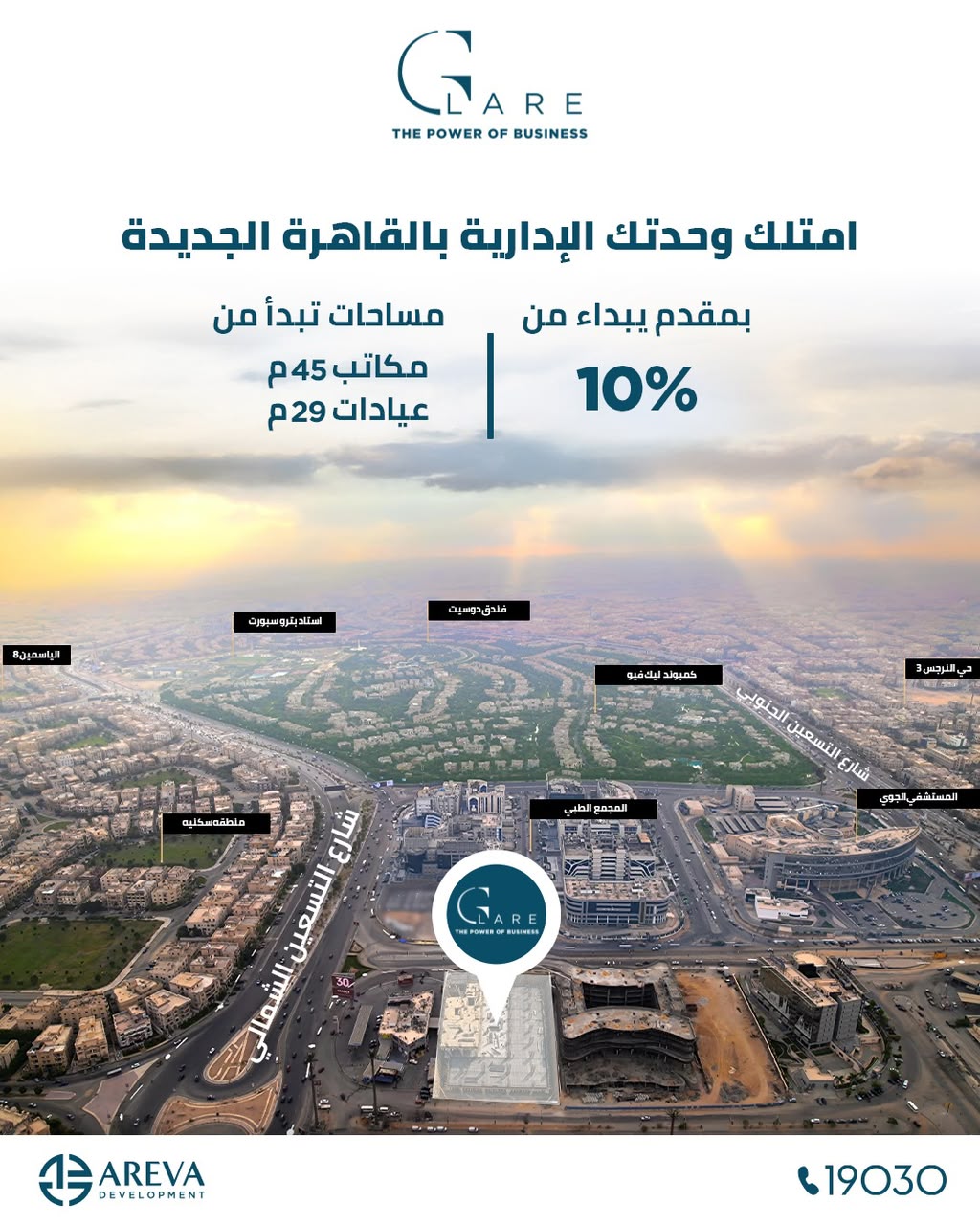
For buyers reviewing Medical Clinics in Fifth Settlement within a mixed-use setting, Glare by Areva Development offers a practical example of the features worth assessing. The project is in Sector One, directly on North 90th Street, beside Air Force Hospital, between the banking district and the medical sector, and close to the monorail. That setting connects business-related movement with established healthcare activity, while still requiring each buyer to assess the individual unit and intended specialty.
Glare spans 6,900 sqm. Buildings occupy 30% of the site, with the remaining area devoted to plaza and services, including an internal plaza of approximately 2,500 sqm. It combines Commercial, Administrative, and Medical uses, with two underground garages, two ground commercial floors, and five administrative/medical floors. Separate entrances and general receptions are designed to organize different visitor journeys.
Operational features to review include a garage for roughly 500 cars, EV charging, smart systems, double-insulated panoramic glass, antibacterial paint, anti-slip floors, accessibility corridors, and six bathrooms on every floor. Administrative and medical units are fully finished with central air conditioning. These are stated project specifications that a buyer can confirm through the agreement and plans; they are not a guarantee of leasing ease or investment returns.
Handover is planned for 2028, with a 10% down payment and instalments of up to eight years. Areva Development is backed by Nozha Group, which has more than 40 years of experience, and the project has received international recognition for its mixed-use and sustainable design. Those points may inform a comparison, but the purchase decision should remain grounded in total cost, exact unit position, intended use, and personal financial capacity.
The bottom line
The best clinic is not automatically the largest, closest to the road, or attached to the longest instalment plan. It is a unit that patients can reach without friction, that a practitioner or tenant can operate efficiently, and whose size, finish, and floor support the intended service. Start with use, test the route, then review the full cost and documents before making a commitment.
With that approach, investing in medical clinics becomes a more measured decision. A clinic may be a suitable home for a professional practice or a real-estate portfolio, but its potential comes from alignment between location, operations, financing, and a genuine market need—not from a label alone.
This article provides general educational information only. It is not personal investment, legal, or medical advice, and it does not guarantee rental income, investment returns, leasing outcomes, or price appreciation. Readers should assess their own objectives and circumstances and consult suitable qualified professionals before making an investment decision.
To Know More Details Contact us now through 01094942833 Or whats up